Where we are today: current economic trends
Our Economy: A Strategy for Southwest NH aims to help regional economic stakeholders to build knowledge, set goals, and take action on issues vital to advancing regional prosperity. This economic profile focuses on that first item—building knowledge. It summarizes key factors shaping the current state of the regional economy and highlights trends that a forward-looking economic development strategy should reflect and address. The economic profile doesn’t capture every aspect of the regional economy. Rather, it serves as an educational resource and discussion-starter for community members interested in helping Southwest NH thrive.
For more information about how the economic profile fits into the overall process of Our Economy, please visit the about page. If you’re interested in sharing your perspective on regional economic issues, you can contact the project team here.
The pandemic was a population inflection point, turning losses into gains.
From the Great Recession of 2008 to coronavirus pandemic of 2020, the Monadnock Region experienced a small but steady decline in population. In Cheshire County, which serves as a rough proxy for the region, the population dropped by about 1,500 people over that period, or about 2 percent.
The pandemic jump started an upward population trend, with over 650 people moving to Cheshire County in 2020. The influx is attributable a nationwide trend where many urban residents suddenly found themselves working remotely, stuck in cramped living quarters, and unable to take advantage of the cultural amenities that had been a major selling point for city living. Across the country, rural areas, including the Monadnock Region, saw newcomers arriving in search of more space and attracted by the relatively affordable home purchase prices.
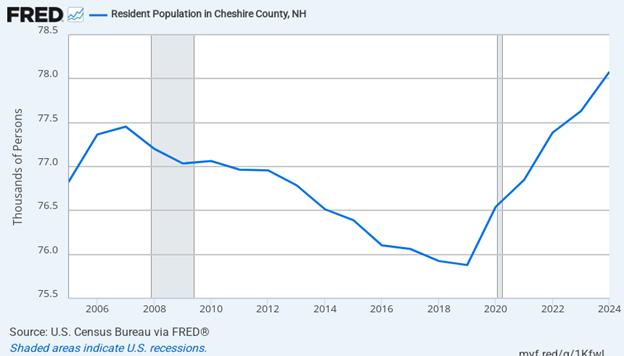
In the Monadnock Region, many of these urban transplants have opted to remain even as the public health emergency has faded into the rear-view mirror. Not only that, but the region has continued to attract new residents, with year-over-year growth through 2024. Since 2020, Cheshire County has added about 1,500 more residents. In recent years, new residents most commonly originate from Massachusetts, followed by other areas of New Hampshire, and, to a significantly lesser degree, Vermont, New York, and Rhode Island.
While the pandemic represents an inflection point for the region’s population, the amount of growth should not be overstated. Since beginning of the pandemic, it has been roughly on par with the nationwide growth. Across the New Hampshire as a whole, as well as the neighboring states of Vermont, Massachusetts, and Maine, the rate of population growth has been substantially higher.
The size of the regional workforce has yet to recover from the pandemic.
Although the region’s total population began to rise in 2020, the size of the labor force has seen persistent losses. In the decade prior to the pandemic, the labor steadily declined, dropping from a previous peak of 42,600 people in 2012 to 41,000 in 2019, a decrease of 1,600 people. As was the case in other parts of the country, the Monadnock Region labor force experienced a precipitous decline during the early months of the pandemic, at the height of the public health emergency and mandatory stay-at-home orders. Nationwide, the size of the labor force has recovered and surpassed its pre-pandemic level. Across New Hampshire, recovery has been more muted but the trend is positive. In Cheshire County, the size of the labor force has only budged upward, from approximately 40,000 people in 2020 to 40,200 people in 2024.
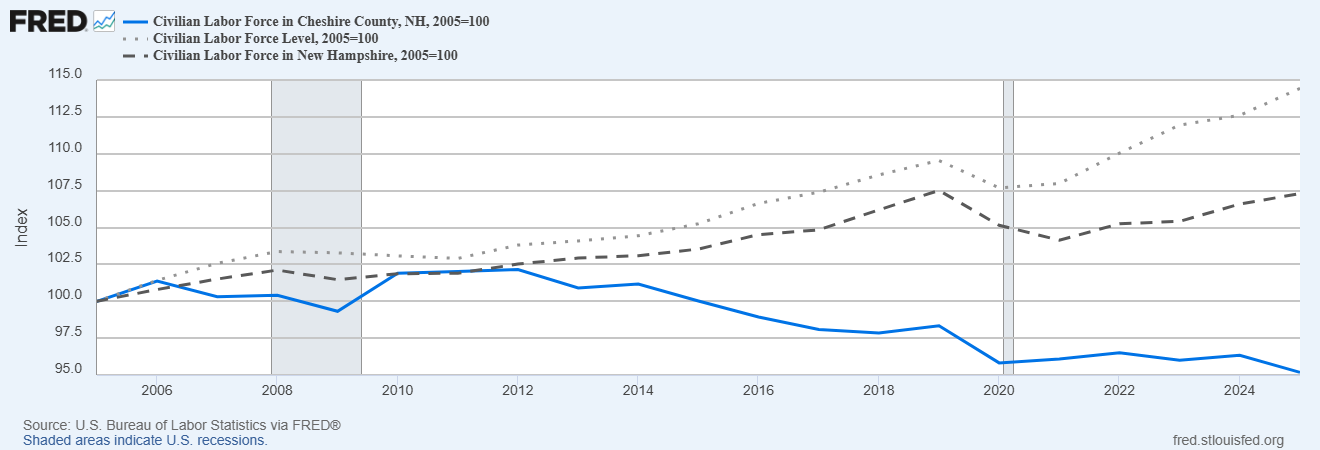
In summary, across the country and state, the pandemic temporarily reversed an upward trajectory. In the Monadnock Region, the pandemic accelerated a downward trajectory, which then stabilized and has remained essentially flat since.
The divergence in fortunes might be attributed to a variety of factors. A key influence is likely the region’s aging demographics. In Cheshire County, almost a quarter of the population is 65 years of age or older. Nationwide, only 18 percent of the population is within this age bracket. While across the country many older workers opted to retire during the pandemic, the wave was perhaps higher in the Monadnock Region, given the comparatively high percentage of the workforce near or entering retirement age.
Although the region’s total population is increasing, this has not resulted in a larger labor force. There may be several causes for this. For instance, new residents might be joining the workforce, but their numbers only offset potential decreases rather than boost overall labor force growth. Another reason may be that many new residents are themselves retirees, attracted to the region by its high quality of life, and not participating in the labor force.
The trends in labor force data corroborate reports from regional employers that workforce recruitment and retention is one of their top challenges, impeding their ability to take on additional work and leading to long project queues. Statewide data shows that job openings still outnumber unemployed individuals. The State of New Hampshire Workforce Assessment (2022), projects that the South-West Collaborative Economic Development Region, which includes Cheshire and Sullivan Counties, will have roughly 77,000 job opening over the next decade in a wide range of high-demand occupations, from registered nurses, to carpenters, truck drivers, plumbers, accountants, and more.
In short, the region’s workforce shortage is one of the key challenges it must address to ensure that its employers continue to thrive, and, by extension, its communities do as well.
K-12 and college enrollments continue to drop region-wide
Acknowledging that the region is experiencing a labor shortage naturally leads to the question, “where will we find the workers we need?” Our educational institutions are certainly one place to look, as they play an important role in preparing students to launch their careers and enter the job market.
In general, enrollments are down across both public K-12 schools as well as institutions of higher education. Over the last decade, enrollments at public schools, including both public school districts and charter schools, have declined by nearly 10 percent. The drop slightly outpaces the decline seen in enrollments statewide, which decreased by about 9 percent over the same period.
Fall Enrollment, Monadnock Region Public Schools, 2016-2025
| 2016 | 2025 | Net Change | % Change | |
| Public District | 13,047 | 11,539 | -1,508 | -11.6% |
| Charter | 210 | 445 | 234 | 111.9% |
| Total | 13,257 | 11,984 | -1,273 | -9.6% |
Public data for enrollments at institutions of higher education are more piecemeal in availability. Consequently, it’s more difficult to clearly illustrate trends across higher education over a uniform period. However, the data that is available shows that Keene State College has experience steep losses in enrollment over the last 15 years, dropping by about half. Antioch University New England, meanwhile, which concentrates on graduate studies in specific fields, has grown in enrollments over recent years. River Valley Community College enrollments have held relatively steady. Data for enrollment at Franklin Pierce University’s flagship campus in Rindge are not publicly available. Enrollment across campuses totaled 1,618, with 99 additional online learners.
| Beginning Year of Comparison Period | Enrollment | End Year of Comparison Period | Enrollment | |
| Keene State College | 2010 | 5,738 | 2025 | 2,794 |
| Antioch University – New England | 2014 | 660 | 2024 | 995 |
| River Valley Community College | 2019 | 1,080 | 2025 | 1,010 |
New educational and workforce development initiatives aim to recruit and retain skilled employees.
The shrinking pool of K-12 and college enrollees underscores the need to recruit more students to the region while also making proactive efforts to retain those who are already here. Many organizations in the region are working hard to do just that, launching innovative educational and workforce development programs. Examples include:
- A new precision optics certificate at Keene State College.
- Nationally certified carpentry and sustainable prefabricated construction apprenticeships, offered by Bensonwood.
- A streamlined process, facilitated by the Greater Monadnock Collaborative, where prospective employees can submit their resume to multiple manufacturing at once.
The region’s workforce possesses notable specializations, particularly in precision manufacturing.
Although the region is experiencing significant workforce challenges, it also possesses substantial strengths. For example, the region’s workforce possesses a high degree of specialization in certain industries. These specializations would in some cases be difficult to find or replicate in other parts of the country and represent a regional competitive advantage.
One way to measure workforce specialization is by “location quotient,” which measures the concentration of employment in a given economic sector in a local geographic area, as compared with a reference area, typically the country as a whole, the approach taken here. In looking at employment location quotients for the three counties within or overlapping with the Monadnock Region, several workforce specializations rise far above the rest. For example, the location quotient for machinery manufacturing in Cheshire County is 9.52, signifying that employment in that sector is over nine times more concentrated compared with the nationwide proportion of workers employed in that sector. Cheshire County ranks 39th out of nearly 2,900 counties across the country. Employers in the region that fall under this industry classification include Precitech, Nanotech, Timken, and others that manufacturing machinery or machine components. Cheshire County’s specialization in machinery manufacturing is due in large part to the cluster of optical manufacturers located in the region.
Top 10 Workforce Specializations (Location Quotient) in Monadnock Region Counties. (Higher dot = more specialized, larger dot = more workers employed).
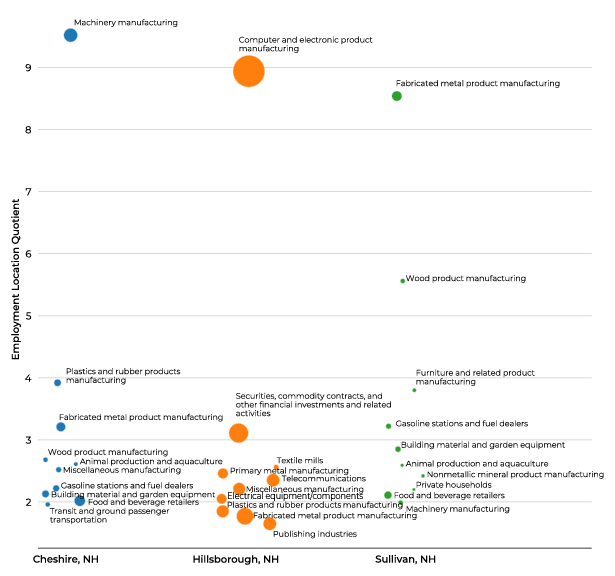
Source: Quarterly Census of Employment and Wages, 2024 Annual Average, U.S. Bureau of Labor Statistics. Economic sectors reflect 3-digit codes under the North American Industry Classification System (NAICS).
Limited housing supply locks out the workers our region needs to thrive.
Meeting the region’s workforce needs will require an “all-off-the-above” approach, both retaining the current and prospective workers who live here today and attracting new workers from outside the region. The ability to do either hinges on expanding the housing supply across a variety of housing types.
The housing market remains tight, both for renters and prospective homebuyers. As of 2023, the rental vacancy rate in Cheshire County was 1.8 percent, well below the 5 percent considered indicative of balanced market with enough slack to accommodate renter demand. Housing inventory remains low, with new listings in Cheshire County lagging slightly behind the nationwide trendline.
New Home Listings in Cheshire County and the United States
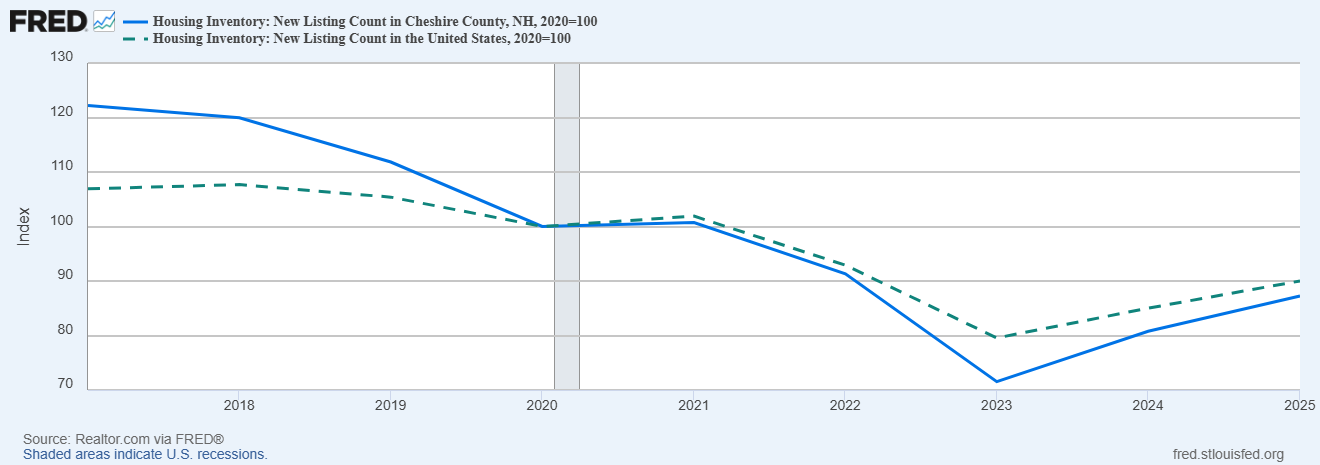
Source: Realtor.com via FRED.
The lack of both rental stock and inventory for sale prevents new workers from relocating to the area. It also elevates prices for current residents that are renting and those that are looking to purchase a home.
As of 2024, the median gross rent in Cheshire County was $1,374, a $360 (36 percet) increase compared with a decade earlier. The upward trend is even more pronounced in the homeownership market. While, nationwide, the trend in the median list price has flattened since 2022, it continues to climb in Cheshire County. Historiclaly, the median home list price in Cheshire County have been lower than the nationwide figure, but today the reverse is true. November 2025, the median list price in Cheshire County was nearly $500,000, whereas across the U.S. it was $415,000.
Median Home List PRice
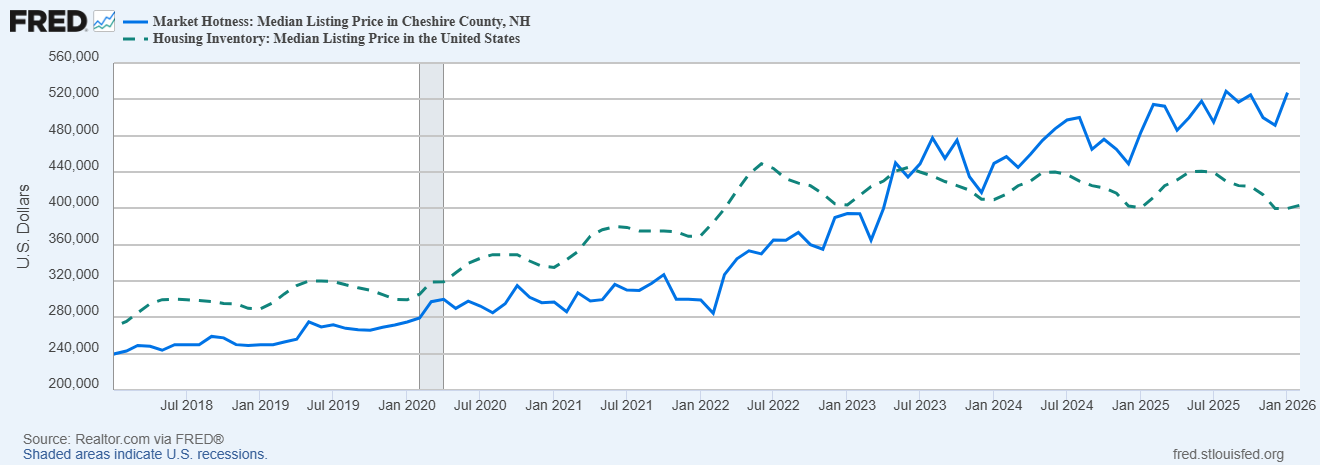
Source: Realtor.com via Fred. https://fred.stlouisfed.org/graph/?g=1P7wZ.
For more in depth information about the region’s housing trends, please reference the 2023 Southwest NH Regional Housing Needs Assessment.
Work is Underway to Expand Childcare, but Gaps in Access Persist
The coronavirus pandemic threw into stark relief the critical role that childcare plays in the lives of working families, and, by extension, their employers and the wider economy. Prior to the pandemic, the importance of early childhood education and care were well-known within the education and social services sectors, but it was the sudden disruption of the public health emergency, the temporary closures and reduced staffing among childcare providers, and the resulting inability of working parents to remain in the labor force that created a more widespread understanding that childcare is a lynchpin necessary for our economy to function. Prior to the pandemic, childcare was not at the forefront of conversations about economic development. Today, it is.
Across the State of New Hampshire, demand for childcare services exceeds the available supply. The shortage is well-known to any parent who has recently sought to enroll a child with a daycare provider. Infant care is especially scarce. Expecting parents are commonly asking to be placed on provider waitlists soon after learning they are pregnant.
Researchers have made some progress in estimating the gap between supply and demand, although there is still much uncertainty on the topic. In a 2025 report, the NH Fiscal Policy institute estimated that there were approximately 54,000 children in need of childcare services statewide. Within the same period, there were fewer than 45,000 licensed childcare slots in the state, yielding a gap of about 9,000 slots. As NHFPI notes, many childcare providers are operating below their licensed capacity, due to staffing shortages. As a result, the gap between supply and demand is likely higher than what available data suggest. In addition, NH FPI’s analysis is limited to current New Hampshire households, ignoring those that the state and region would need to recruit in order to meet its workforce challenges.
Since not all of the data that NH FPI relies on for its statewide analysis are publicly available at the county or regional level, quantifying the local childcare gap is more challenging. However, earlier work commissioned by the University of New Hampshire determined that families in the southwestern portion of the state had relatively low levels of access to licensed childcare services, compared with families living elsewhere in the state.
Even when families are able to find an available childcare slot, the costs of that care can pose a severe financial burden. According to NHFPI, “Between 2022 and 2024, tuition for an infant and four-year-old in center-based care in New Hampshire averaged nearly $30,000 annually.” This equals nearly 20 percent of a median-earning married couple’s income. Even with the recent expansion in NH Child Care Scholarship Program, the median-earning household remains ineligible and must shoulder the full cost of early childhood care.[4]
Undersupplied childcare slots and steep costs mean that many parents stay at home rather than remain in the workforce. Per the NHFPI:
From August 2023 through August 2024, an estimated average of 13 percent of employed Granite State parents reported leaving a job, and an additional 7 percent reported losing a job, because they needed to care for their children. On average, an estimated 12 percent of parents reported they did not look for a job at all, while 47 percent reported reducing their work hours, to care for their children.
The main driver in the childcare shortage is the low compensation that early childhood caregivers and educators receive. In 2024, the average hourly wage for an early childhood care and education professional was $16.62 per hour. This is less than the median wage for a retail worker and far lower than the median for all NH occupations. Meager pay makes recruitment and retention extremely difficult, and many childcare providers are operating far below their licensed capacity due to staffing shortages. Pandemic-era federal supports helped bring workers into the field, but these limited-time grants ended in 2023, the number of childcare workers in the state has subsequently declined.
There’s no question that the childcare sector and the families that depend on its services face significant challenges—challenges that likely won’t be fully resolved without fundamental changes to the way in which childcare is supported as a public good. However, there is important work happening at the regional level to expand access to affordable, high-quality childcare services.
One example is the Bring it Home Program, an initiative of the Monadnock Economic Development Corporation (MEDC). The initiative aims to provide new or prospective home-based providers with business advising as well as grants for renovations necessary for licensure or improved operations. The program recognizes that some parents caregiving for their own children at home and otherwise locked out of the labor force may be interested in generating income by providing care for the children of others. In addition, home-based providers tend to have lower operating costs than center-based facilities. Consequently, they may be able to provide childcare services at a comparatively affordable price point. To date, the program has seen strong interest from prospective providers and may help develop a model for expanding childcare access in other parts of the state, especially in rural areas, which tend to have few center-based options.
Many essential workers in the region do not make a living wage
While some parents may prefer to stay at home with their children, many families do not have that option, since a single source of income is often not enough to meet basic household needs.
According to analysis by the MIT Living Wage Institute, a single parent with two children would require a wage of $59.07 per hour to meet basic living expenses in Cheshire County. A small minority of workers are able to command such a wage. Even with a two-adult household where one is staying at home to serve as the children’s caregiver, an hourly wage of $44.15 is necessary. The average wage for many occupations is far below this level. For example, the median wage for a worker employed in the construction industry is $31.16 per hour. Healthcare support workers earn an average of $22.20 per hour. The median retail worker earns $27.48 per hour.
| 1 Adult | 2 Adults (One Working) | 2 Adults (Both Working) | |
|---|---|---|---|
| Living Wage | 59.07 | 44.15 | 31.13 |
| Poverty Wage | 13.13 | 15.87 | 7.93 |
| Minimum Wage | 7.25 | 7.25 | 7.25 |
Overall economic activity grows in the region, but trends vary by sector.
An imperfect yet common indicator of economic activity is Gross Domestic Product (GDP). In loose terms, GDP can be understood as the value of goods and services produced by an area’s economy less the value of goods and services used up in their production. Although GDP is more well-known as a topline indicator for national economic activity, the U.S. Bureau of Economic Analysis also tracks GDP at the state and county level, breaking out the date by major economic sector. Local GDP trends can serve as a rough barometer for comparing economic trends in different areas across the country.
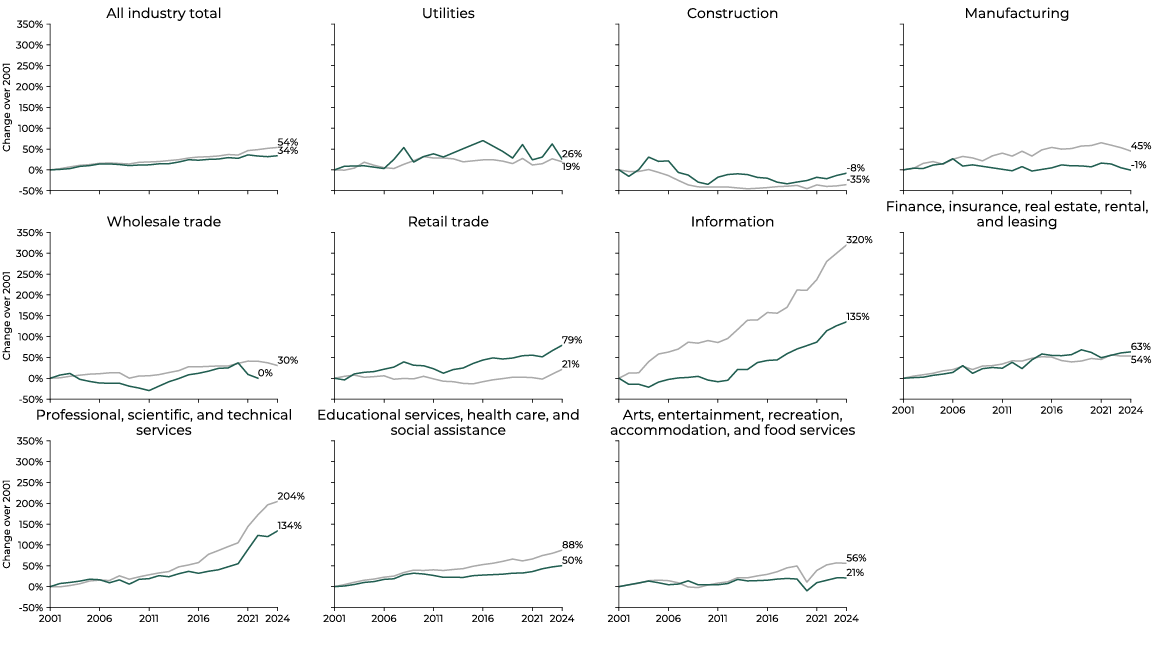
Comparing GDP trends in Cheshire County with those across New Hampshire, it’s first worth noting that GDP has grown in both areas, but that growth has been slower in Cheshire County over the last 20-plus years. From 2021 through 2024, overall GDP increased by 34% in Cheshire County versus 54% across the state. From sector to sector, there has been significant variation in growth (or lack thereof). For example, construction-related GDP has decreased both in Cheshire County and statewide, by 8 percent and 35 percent respectively. Manufacturing GDP dipped by 1 percent in Cheshire County, while it grew by 45 percent statewide. Retail growth in Cheshire County (79%) has outpaced the statewide gains (21%). Growth in Cheshire County’s information sector has lagged far behind the statewide trend, increasing by 135% and 305% respectively.
Gross Domestic Product (GDP), % Change over 2001 Baseline, Cheshire County (Green) vs. New Hampshire (Gray)
Most towns in the region are now wired up with community-wide fiber optic internet service.
As recently as five to ten years ago, a lack of broadband connectivity was widely recognized as one of the region’s major challenges inhibiting economic development. Many residents in the region, especially in smaller, less densely populated communities, had access only to legacy internet technologies such as copper wire-based Digital Subscriber Line (DSL) service. Fast forward to today, and over 92% of residential addresses in Cheshire County have access to wireline broadband with data transmission speeds meeting or exceeding 100/20 Mbps (download/upload), the FCC’s current threshold for determining if service qualifies as “broadband.”
This success story was driven in large part by an innovative model for broadband deployment that became colloquially known as the “Chesterfield Model,” after the Town of Chesterfield, NH, the first community in the state to pioneer it. The model involved a public-private partnership where a town issued broadband infrastructure bonds to finance a portion of network buildout while an internet service provider (ISP), built and managed the network while also paying down the debt through levying a surcharge on subscribers. More details on the Chesterfield Model can be found in the Monadnock Broadband Implementation Guide, which was published in 2021 and served to help replicate the success in Chesterfield to other communities.
Broadband expansion in Chesterfield resulted in completion of a town-wide fiber optic network, offering symmetrical download/upload speeds of 1 gigabit and faster. Many other towns have similarly achieved “gigabit community” status with fiberoptic service now available townwide. As of June 30, 2025, fiber optic service is available at over 76% of addresses across the county. Fiber optic service is seen as a “future proof” infrastructure since network speed increases do not require replacement of the fiber cable itself—just sending and receiving equipment (e.g., routers, switches).
The expanded availability of broadband generally and of fiber optic service specifically means that the region is better positioned to participate in internet-based activities with high bandwidth needs, e.g., telehealth, remote medical diagnostics, distance learning, real-time collaboration with remote workers, online content creation, and more.
Assessed property value has grown across the region, but generally lags behind the state as a whole.
Assessed property value is an important regional economic indicator. It represents the tax base through which municipalities primarily raise revenues to support public services and undertake public works projects. If the tax base is growing, then a community has the ability to improve services or reduce the tax rate for local property owners.
Adjusted for inflation, the equalized assessed property value in Cheshire County has grown by just over 56% from 2015-2024, as compared with the 68% increase statewide over the same period (SWRPC analysis of NH Department of Revenue Administration Data). The increase is in large part due to market conditions, namely, the surge in home prices that took off in 2020, in tandem with the pandemic. A smaller portion of the increase is a result of new development activity that led to expansion in the tax base. Teasing out the precise contributions of these different factors would require more in-depth analysis.
One way to understand relative amounts of assessed property value across communities is by examining equalized value per capita. Each year, the NH Department of Revenue Administration conducts an equalization process to account for variations in assessing practices and local revaluation schedules. Dividing this figure by a municipality’s population provides a rough measure for how much taxable wealth a town has per person.
Looking at the Monadnock Region, there is significant variation between towns based on this metric. In 2024, the range extended from a minimum of $109,000 per capita (Hinsdale) to $371,000 per capita (Harrisville). In the same year, only seven Monadnock Region communities exceeded the statewide average of nearly $250,000 assessed property value per capita. The respective trajectories of individual communities over the last decade has also varied considerably, with some communities exhibiting modest growth and others nearly doubling in per capita value. All communities in the Monadnock Region saw some growth—and none saw losses.
The regional economy is more resilient than many other rural areas nationwide.
Across the country, rural places have faced significant economic headwinds in recent decades, grappling with challenges such as offshoring of manufacturing jobs, outmigration of young people, persistent consolidation of rural industries (e.g., agriculture), and a general shift to a knowledge-based economy that concentrates in and around urban areas.
The Monadnock Region has itself encountered these challenges, but it has weathered them better than many rural areas nationwide. Analysis by the Economic Innovation Group (EIG) categorized Cheshire County as exhibiting “persistent prosperity” over the period from 2000 though 2018. The classification indicates that Cheshire County was in the top two quintiles of economic well-being among all counties nationwide over the entire 18-year period considered. Only 21 percent of rural counties across the country meet these criteria. EIG measures economic well-being using its Distressed Communities Index (DCI), which assesses local economic well-being based on indicators such as poverty, adults not working, and job growth.
Putting Southwest NH in the national context highlights that it has demonstrated relative resilience in recent years in face of a broader economic context that has favored urban places. It has pulled on strengths such as its highly educated, skilled workforce to innovate and adapt to technological disruptions and a competitive global marketplace.
More recent data from EIG shows that, as of 2023, Cheshire County remains in the top two quintiles nationwide for economic well-being, according to the DCI. Although it’s easy to focus only on the region’s challenges, EIG’s data and analysis show that the region combines a rural way of life with economic prosperity in a way that’s unique. It possesses a wellspring of assets and strengths that will help it maintain and improve its resilience in the years to come. You can read more about these strengths in the Economic Temperature Check.
Interested in Learning More?
If you’re interested in digging into some of the topics raised above in greater detail, along with other issues important to the development of the regional economy, you can visit Our Econonmy’s data page, which contains a working catalog of issue briefs.