The Cost of Electricity in the Monadnock Region is High
Anecdotal evidence suggests that energy costs – which include electricity and fuel for heating and transportation – strain Monadnock Region residents as the cost of living in the New England area continues to increase. According to the U.S. EIA, New Hampshire has one of the highest average retail electricity prices in the country, averaging 22.96 cents per kilowatt hour in 2023 compared to the US average of 12.68 cents per kilowatt hour. Within New England, New Hampshire’s retail electricity price is surpassed only by Connecticut and Massachusetts at 24.24 cents per kilowatt hour and 23.21 cents per kilowatt hour respectively.
Over the last five years, New Hampshire has experienced a net increase in average price per megawatt hour of electricity as a whole and within individual sectors. Residential customers typically pay the most per megawatt hour compared to the commercial and industrial sectors due to economies of scale. These high prices can be attributed to a variety of factors including price increases in petroleum-based fuel stocks for electricity generating and fixed-rate utility fees associated with infrastructure updates
Average annual price of electricity per kilowatt hour for all sectors in New Hampshire from 2019 to 2023.
| Year | Average price per kilowatt hour for all sectors (in cents) |
| 2019 | 17.15 |
| 2020 | 16.63 |
| 2021 | 17.37 |
| 2022 | 21.07 |
| 2023 | 22.96 |
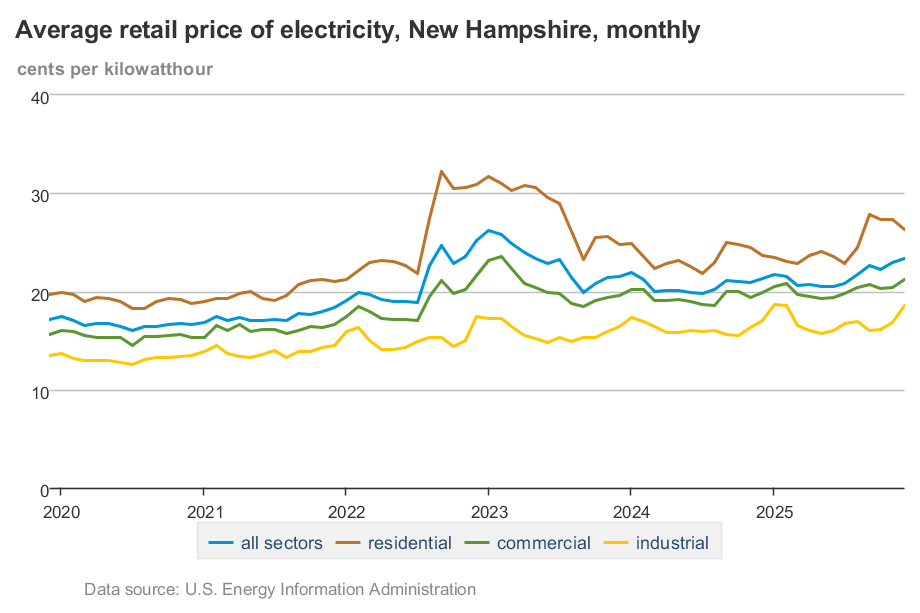
New Hampshire also requires fixed-rate utility fees for electricity delivery. Fixed rates cannot adjust to market fluctuations, forcing utilities to absorb cost changes. When utilities can no longer absorb increasing costs associated with grid updates, aging infrastructure repairs, labor, and effects of inflation, end-use consumers experience rate hikes. Most recently, Eversource NH customers received a rate hike from about $14 per month to around $20 per month despite New Hampshire’s electricity consumption having reduced over time, most likely due to increases in building energy efficiency using measures such as building weatherization, Energy Star rated appliances, and the NH Saves program.
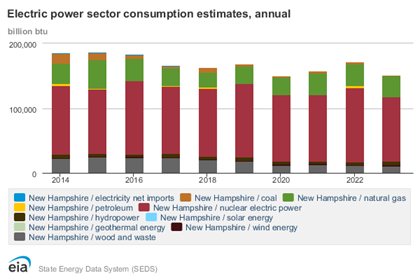
In 2023, 56 percent of New Hampshire’s total generated electricity was provided by the Seabrook nuclear power plant. As shown by EIA, natural gas provided another 25 percent, renewables (including biomass and hydropower) provided 18 percent, and the rest was provided by petroleum and coal. For the last five years, New Hampshire has not imported any net electricity, instead exporting its surplus electricity. In 2023, the Granite State generated 16,824,999 megawatts of electricity and exported 5,628,581 megawatts of electricity via interstate trade, per EIA. However, New Hampshire imports its natural gas for in-state electricity generation, making the cost of electricity generation vulnerable to changing market conditions.
New England’s energy mix has shifted away from coal and oil-based electricity generation but has significantly increased its reliance on natural gas, as documented by ISO New England.
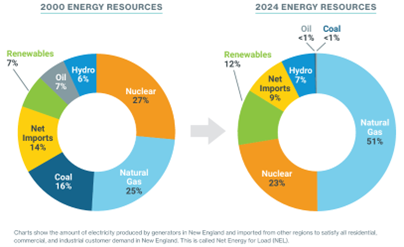
Additionally, as the ISO New England regional grid transitions from reliance on high greenhouse gas-emitting fossil fuels to less greenhouse gas-emitting energy sources, New England’s grid is augmented by (mostly) natural gas from New York, Quebec, and New Brunswick. Heightened demand for natural gas combined with a relative dearth of supply-boosting infrastructure projects have further increased the cost of natural gas and its susceptibility to changing market conditions. When region-wide demand for electricity (heat waves) or heating (cold snaps) increases, natural gas prices – and therefore the cost of generating electricity – spike for the whole grid, including natural gas-dependent New Hampshire, as described by ISO New England.
Availability of Three-Phase Power is Limited
Three-phase power is scattered across the Monadnock Region. Most AC powerline infrastructure in the region is single-phase and follows transportation corridors, but three-phase power is not so ubiquitous, as shown in Eversource. Three-phase power is delivered by three powerlines, each carrying electrical current out of sync with one another, thereby providing a consistent power flow useful for commercial, industrial, multiunit residential applications. Hosting capacity refers to how much power the lines and associated substation can handle at any given location and time. Low hosting capacity restricts the quantity of power that can be added to the grid by Distributed Energy Resources like net-metering solar panels, community power projects, or small commercial installations.
While numerous towns throughout the Monadnock Region have access to three-phase power, three-phase power infrastructure and hosting capacity are primarily concentrated in and around Keene, as shown by Eversource. This is likely due to the high population density of the greater Keene area and its history of manufacturing. Eastern Monadnock also has notable three-phase power infrastructure, though its hosting capacity is generally lower than in Keene, according to Eversource. Like single-phase powerlines, three-phase powerlines often follow transportation corridors. However, unlike single-phase infrastructure, segments of three-phase power infrastructure are not always connected and hosting capacity is not necessarily uniform, even along individual corridors. Most areas with three-power have hosting capacities below one megawatt, but some areas have lines with hosting capacities ranging from three to five megawatts. One location in Greenville links to a line outside of the region with 7.5 megawatt capacity.
Eversource NH phase capacity in the Monadnock Region.
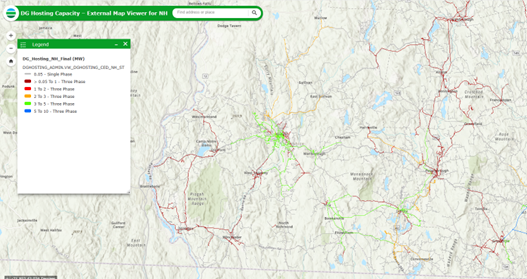
Notable transportation corridors that are missing sections of three phase power include NH Routes 9, 10, 12, and 101, however some smaller roads – especially in eastern Monadnock – have significant connections to three phase power, as shown by Eversource. The vast majority of the region is served by Eversource NH, but the northwestern corner of the region is primarily served by Liberty Utilities. Although those towns appear to have three-phase power infrastructure, Liberty reports insufficient hosting capacity, so the lines are not currently in use according to Liberty Utilities.
Liberty Utilities phase capacity in the Monadnock Region.

Three-phase power is often required for industrial or commercial development, so lack of three-phase power can hinder economic and renewable energy project development. Limited hosting capacity also restricts development as the local infrastructure must be able to safely transmit the increased power flow. Expanding three phase power infrastructure and hosting capacity requires grid upgrades which can be costly and contribute to utility rate increases. Several grid upgrades are scheduled for lines and substations in the Monadnock Region as the ISO New England grid shifts towards including more power from renewables, per ISO New England.
Currently, there are Few Utility-Scale Renewable Projects in the Region, but some Medium-Scale Projects have come Online.
New Hampshire generates 18 percent of its electricity from renewable sources, far lower than surrounding states. This is likely attributable to a few factors including decreased investment in clean energy by the state government, low reimbursement rates, and restrictive net-metering rules. The state’s renewable energy is primarily generated by hydropower followed by biomass and wind. Solar accounted for two percent of the state’s electricity generation in 2023, as reported by EIA. This figure includes small-scale solar installations like residential rooftop net-metering projects.
Percentage of net energy generation by large and small solar installations in New England in 2023.
| State | Percent of energy generated by solar power in 2023 |
|---|---|
| Massachusetts | 24 |
| Vermont | 16 |
| Maine | 13 |
| Connecticut | 4 |
| Rhode Island | 9 |
| New Hampshire | 2 |
New Hampshire has few utility-scale renewable energy projects – including community solar – because the state’s and commercial projects over one megawatt, as discussed by Canary Media. Economies of scale often help utility-scale projects achieve financial feasibility, so restrictions on project size due to net-metering rules can be prohibitive for renewable energy development, especially for administrative-intensive projects like community solar installations. However, a few larger renewable energy projects have been developed in the Monadnock Region, including the City of Keene’s solar arrays, Antrim Wind, and ReVision Energy’s community-owned solar installation in Jaffrey.
The City of Keene generates over 2.4 million kWh of electricity each year from its municipal solar arrays. The city first installed a rooftop solar array on the municipal complex which generates 643.2 kWh of electricity per year. The City later installed mounted solar to address the energy needs at the Wastewater Treatment Plant which has historically been the largest consumer of electricity in Cheshire County, as detailed by ReVision Energy (photo featured at the top of this page). This 1.36 megawatt installation added significant generation capacity to the City’s renewable energy portfolio, which now covers most of the City’s municipal electricity needs, according to ReVision Energy. Both projects were funded by Power Purchase Agreements, meaning that the City did not have to provide the upfront capital for the installations, as described by ReVision Energy. Instead, Keene pays the investor for the electricity the city consumes and ultimately has the option to purchase the arrays at a discounted rate to own all of the power generated from the arrays. The Wastewater Treatment Plant installation was financed by Keene-based Ashuelot River Hydro Inc. Both installations are serviced by ReVision Energy, per ReVision Energy. Keene also has 278 residential solar projects and 44 commercial/industrial projects equaling 6115 kW of AC power, according to City of Keene.
Antrim Wind is the Monadnock Region’s single utility-scale power generation facility and is located in the Town of Antrim. The nine-turbine installation is capable of generating 28.8 megawatts of renewable energy. As described by TransAlta, Antrim Wind is owned and operated by a subsidiary of TransAlta and sells approximately 30 percent of its power to the NH Electric Co-op and 70 percent to Massachusetts-based PartnersHealth through Power Purchase Agreements. The installation came online in late 2019 after nearly a decade of planning and negotiation. The project prompted controversy in the area due to potential noise pollution, habitat and conservation fragmentation, and prominent location on the scenic Tuttle Hill ridgeline, as reported by Canary Media. The Town of Antrim now receives an annual payment of $324,000 from Antrim Wind in lieu of taxes, also reported by Canary Media.
Power generated per year by Antrim Wind measured in megawatt hours using data from EIA.
| Year | Power generated per year (megawatt hours) |
|---|---|
| 2020 | 80,222 |
| 2021 | 78,054 |
| 2022 | 82,787 |
| 2023 | 68,792 |
| 2024 | 70,960 |
| 5-year average | 76,163 |
The Town of Jaffrey is home to New Hampshire’s first community-owned solar project, as covered by Canary Media. Set to go online in 2025, the project will provide 1.3 megawatts of renewable energy to community shareholders, as reported by the Monadnock Ledger-Transcript. The farm is located on Jaffrey’s capped landfill and is managed by ReVision Energy; Hollis Brookline News notes this site is otherwise undevelopable but now provides lease income to the town. Jaffrey residents and other Eversource customers are eligible to purchase 25-year allotments of power generated by the solar farm to offset portions of their electricity consumption, per the Monadnock Ledger-Transcript. Shares are based on customers’ electricity consumption and can be purchased upfront or financed with ReVision for a $1000 deposit. Share owners will also receive the 30 percent tax credit provided by the 2021 Bipartisan Infrastructure Act, as described by NH Business Review.
Another innovative program in the eastern part of the Monadnock Region is the Peterborough Renewable Energy Project (PREP). Run by the Town of Peterborough and composed of local residents, PREP was conceived after the passing of a 2021 warrant article “committing the town to transition to 100% renewable sources of electricity by 2030 and for all other energy needs by 2050,” as described by PREP. PREP developed a plan in 2022 to achieve this goal and is now in the process of implementing the recommendations. Current initiatives include Energy Coaching, local financial assistance like the HeatSmart+ program, and assistance with filing for state and federal tax credits, as described by PREP.
Monadnock Region Communities are Exercising Agency through Community Power Aggregation
Community Power programs refer to locally controlled electricity supply programs that communities can develop to benefit their residents. Community Power programs provide an opportunity for local governments to help build resilience through developing local energy projects, such as municipal solar installations, through flexible funding options incorporated within the power contract. These programs can also help achieve lower rate payer costs by aggregating the demand of individual ratepayers within a community and using this leverage to receive better rates for the supply of electricity. Community Power programs were enabled by statute in New Hampshire by RSA 53-E in 2019 and enables Community Power programs to become the default service in communities for which they are adopted. Therefore, when a municipality develops a Community Power program, residents who are existing “default customers” of the region’s utility are automatically enrolled into the municipality’s Community Power program at launch.
Since Community Power programs were enabled in New Hampshire through state law, SWRPC, in partnership with MSH, has presented to (or otherwise aided) 23 individual communities within the Monadnock Region, representing 70% of the municipalities in our service area, as summarized by SWRPC. According to the NH Public Utilities Commission, 11 municipalities in the Monadnock Region have their own Community Power agreements, including Bennington, Greenfield, Hancock, Harrisville, Keene, Langdon, Marlborough, Peterborough, Swanzey, and Temple. The partnership between SWRPC and MSH also helped Cheshire County develop a county-level Community Power plan for which eligible municipalities could join directly through a selectboard vote, as described by SWRPC. Currently, nine municipalities participate in the Cheshire County Community Power program, including Chesterfield, Dublin, Fitzwilliam, Gilsum, Hinsdale, Nelson, Roxbury, Troy, and Winchester, according to CPCNH.